
SNISMs
SNISMs- Combined influence of pH, catalyst and strongly non-ideal solvent mixtures towards boosting acid-catalyzed reactions
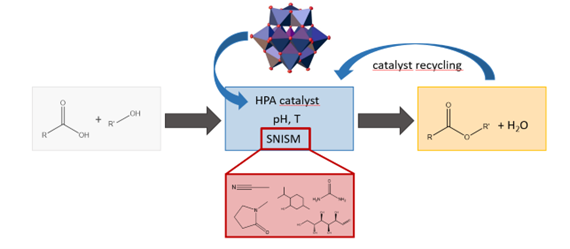
The efficiency of chemical syntheses is determined by the interaction of catalyst and reaction medium. In homogeneous catalysis, high substrate solubility, fast kinetics, high yields and the recyclability of solvent and catalyst are desirable. As acid-catalyzed model reactions, esterifications of various organic acids (e.g. formic, acetic or lactic acid) with short-chain alcohols are investigated, using heteropolyacids (HPA) as catalysts, which are well known and used in the working group in a variety of applications.
Due to water formation during the reaction process, a reaction medium is required that keeps the thermodynamic water activity as low as possible, but at the same time maximizes the activity of the catalyst (proton activity) and the reactants in order to shift the thermodynamic equilibrium to the product side. When using a single solvent, often only one of these properties is achieved, e.g. reducing the water activity while also slowing down reaction kinetics. For this reason, solvent mixtures that deviate from Raoult's law due to strong interactions will be used in SNISMs. These can be, for example, organic solvents in combination with urea, terpenoids or sugars. The influence of SNISMs on the phase behavior, yield and reaction kinetics is not well known so far and will be investigated both experimentally and with a thermodynamic prediction tool.
This project is jointly carried out with the working group of PD Dr.-Ing. Christoph Held at the Chair of Thermodynamics at TU Dortmund University. Funded by the German Research Foundation (DFG) under the funding code AOBJ: 699314.
Contact: Lasse Prawitt (lasse.prawitt"AT"uni-hamburg.de)