Department of Chemistry
Departmentof Chemistry
Photo: FB Chemie/Ehrlich
10 March 2026, by Daniel Wilson
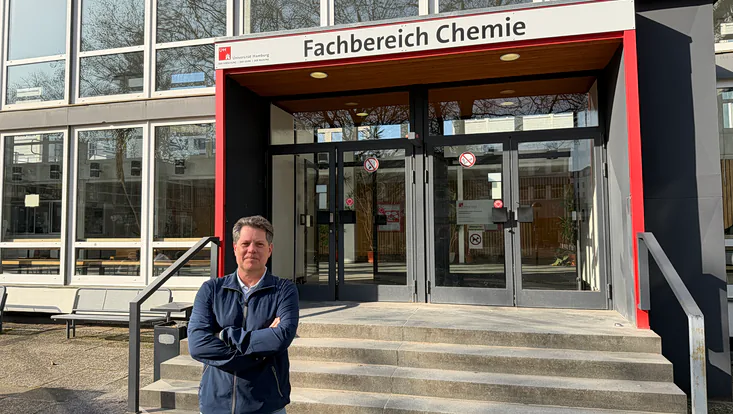
Photo: Daniel Wilson
The research group of Prof. Daniel Wilson at the Institute for Biochemistry and Molecular Biology in the Faculty of Chemistry at the University of Hamburg has been awarded a significant grant from the Deutsche Forschungsgemeinschaft (DFG). This funding enables an international collaboration with Dr. Pohl Milon of the Universidad Peruana de Ciencias Aplicadas (UPC) in Lima, Peru. The three-year project aims to comprehensively investigate the molecular mechanisms underlying bacterial protein synthesis initiation — with a focus on the influence of different start codons and mRNA structures that regulate this fundamental process.
This innovative initiative builds upon a successful prior collaboration, whose results were published last year in Nature Communications (Mar 12, 2025; 16(1):2470; doi: 10.1038/s41467-025-57731-8). That study provided high-resolution cryo-EM structures (2.0–3.0 Å) of bacterial 30S initiation complexes, elucidating how antibiotics such as kasugamycin, edeine, and GE81112 bind within the ribosome and influence specific steps of initiation complex formation. These structural insights into the mechanisms of inhibitor action and the dynamics of initiation were only possible thanks to the excellent cryo-EM facilities at the CSSB Centre for Structural Systems Biology in Hamburg, which underpins both past and current high-resolution structural work.
The current project extends this foundational work by examining how translation initiation occurs on various mRNA start codons, including non-canonical codons like GUG, UUG, CUG, and AUU, both in vivo and in vitro. The overarching goal is to identify the parameters that modulate the fidelity and efficiency of translation initiation, thereby advancing our understanding of bacterial gene regulation strategies. High-resolution cryo-EM structures, combined with biochemical analyses, will be used to decipher the interactions among ribosomes, mRNA, initiator tRNA, and associated factors. The exceptional cryo-EM infrastructure at the CSSB Hamburg has been vital for generating the detailed structures that underpin the previous and ongoing projects.