
Prof. Dr. Werner-Michael Kulicke
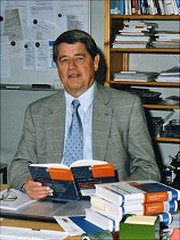
Foto: Kulicke
Im Ruhestand
Anschrift
Kontakt
Schwerpunkte
- Rheology
- The Rheological Circle
- Structure-Property Relationships
- Polymer Analysis
- Hyphenated Techniques
- Linear Polymers
- Polymer Networks
The property of materials, that is what Technical Chemistry is all about. Every industrial process aims for a product with desired properties, for the application as a final product as well as in further proccesing steps. However, the prediction of the properties of a material requires a sound knowledge of the underlying molecular structure. Especially for Macromolecular (polymeric) materials the structural variations are manyfold, even for chemically identical monomeric subunits. It is therefore of utmost importance to analyse the structure of a polymeric material and to correlate this structure with the properties to allow for a better understanding, improvement and optimization in a technical application.
Forschungsinteressen
Rheology
Rheological investigations are important in technical applications. Characterization of the property profile of polymer solutions and gels is carried out via their elasticity and flow characteristics. The above-mentioned relationships then enable the rheological variables to be predicted as functions of the molecular parameters. The rheological material functions in the possible forms of stress can be fully recorded by shear experiments, non-destructive oscillation measurements and elongational flow experiments.
 The Rheological Circle
The mechanical determination of the materialfunctions of steady shear flow, small ampliude oscillatory shear and extensional flow allows for a complete characterisation of the visco-elastic material properties of a fluid.
Optical detection of flow birefringence and the respective orientation allows the additional detection of the flow dynamics of polymer molecules and aggregated structures on a molecular level.
Rheo-optical measuring techniques enable the behaviour of polymer fluids, associates and aggregates to be described. Furthermore, the degree of orientation of these supramolecular structures can be determined as a function of the shear rate.
Substances investigated include synthetic polymers, and polymers from renewable resources as cellulose and starch derivatives, fermentation polymers as well as associative thickeners, symplexes and membranes, pastes, emulsions, etc., with their special properties being described in several selected structure-property relationships.
Structure-Property Relationships
One major focus of research is to be found in the setting up of structure-property relationships of water-soluble and water-swellable polymers/polyelectrolytes. In dilute solutions this concerns, for example, the [η]-M and RG-M relationships ([η]: Intrinsic, M: molar mass, RG: radius of gyration). In more concentrated solution, relationships between the molecular structural parameters and the property profiles (thickening, elasticity, orientation, water-retaining capacity, flocculation, stability, gelation, etc.) are determined. Here ηo-M-c and η-M-c-rate relationships are set up (ηo: zero-shear viscosity, η: shear viscosity, rate: shear rate), in order, for example, to predict the thickening effect of polymers. The same applies for the elasticity. Here too, stucture-property relationships can be established between the normal stress, the shear rate, the concentration and molar mass. This enables the viscoelasticity to be predicted in a flowing state.
Oscillation measurements to determine the loss modulus, G'' (viscous component), and the storage modulus (elastic component), G', also enable the viscoelasticity to be characterized in the relaxed state as well as the network structural parameters (mesh width, molar mass between entanglement points, etc.) of polymer solutions and polymer gels (e.g. hydrogels).
The rheo-optical material functions (flow birefringence, flow dichroism and orientation) were also determined qualitatively and quantitatively by us in a rheo-optical apparatus built for the purpose. As a result, it was not only possible to determine the properties profile of complex polymer fluids as an integral for the entire sample but also locally. This includes the determination of gel formation kinetics and the occurrence of gel nuclei before the actual start of gelation.
Polymer Analysis
Polymer analysis investigations are required in order to determine relations such as these. The chemical structure is determined with the aid of IR, UV and above all NMR spectroscopy as well as polyelectrolyte titration. After fractionation by means of size-exclusion chromatography or flow field-flow fractionation, the multi-angle laser light-scattering combined with a detector sensitive to concentration, following used for characterizing the molar mass, Mw, and particle size, RG, also yields the absolute distributions of these parameters. The knowledge of not only the high high or low molar mass tail but the complete molar mass distribution function and the particle size distribution is of utmost importance.
Hyphenated Techniques
Online coupling of fractionation units (size exclusion chromatography (SEC) or flow field flow fractionation (F4)) with multi angle light scattering (MALS) and concentration detection with a differential refractometer (DRI)
Applied Technical Chemistry
Linear Polymers
Linear polymers are used for polymer flooding processes to increase the fluid viscosity and allow for a an enhanced oil recovery. An optimization of this process requires the knowledge of the structure-property relationships of the polymer solution.
Drag reduction describes the effect of linear polymers in solution to decrease flow resistance and enhance the trajectory length of liquid jets. This phenomenon can only be described by correlation to the rheological properties of the solution.
Solid-liquid separation investigates methods for purifying industrial (manufacture of offset printing plates, maintenance of waterways) and municipal effluent (sewage sludge) that require taylored solutions. These suspensions can be flocculated and subsequently clarified with the aid of polyelectrolytes through simple (monoflocculation) or specifically designed combined (dual and double dual flocculation) addition techniques. It was shown only these tailored solutions can provide a sufficient treatment of harbor sediment and an optimized dredging of waterways in Hamburg (Germany) that allows 13.000 ships, including container and cruise ships per anno to enter the harbor.
Antitumor active substances in the form of linear watersoluble glucans that enhance the activity of the immune system can be isolated from yeast and barley. The glucan are succesfully tested in animal experiments and show, regardless of the molar mass, a stimulation of the immunological measures more than commercially available biomedical drugs. Contrary to literature helical structures are not essential for immunological activity.
Modern blood plasma expanders use polysaccharides and in particular hydroxyethyl starch, which is the best-tolerated of all. In recent years it has been shown that intolerance reactions, such as anaphylactic shock and accumulation in the organs may occur. We have synthesized an acetyl starch (2-O acetyl starch) that may overcome these difficulties (patent DE 10 2004 024 241.0).
Polymer Networks
Hydrogels are produced by secondary valency bonding (H bonds, dipole-dipole interactions…) or covalent cross-linking of water-soluble polymers. As superabsorbers these networks are capable of binding a multiple of their own weight in water (drying agents, incontinence aids …).
Ultrasonic gels serve as a contact medium between the ultrasonic source and the patient's skin. They consist of a swelled system of weakly cross-linked polymers. The contact gels required for this have hitherto usually been based on a polyacrylate structure, which was classified as a Category 4 carcinogenic compound (substance with an effect threshold) in the MAK list of maximum allowable workplace concentrations for 2000. The aim is to develop ultrasonic contact gels based on novel cross-linked carboxymethyl starches so that the controversial acrylate gels can be replaced.
Hydrogels can also be manufactured as flat-bed membranes. They can be synhesized by a symplex formation from polyanions and -cations, in the form of bacterial cellulose or from chitosan to obtain stable and yet flexible, transparent and haemostatic membranes. They can be used in various different industrial, medical or pharmaceutical applications (patent DE 10 2004 047 115.0).
Other complex, crosslinked polymer fluids can also be characterized in terms of their viscoelastic properties as for example nanoscale filled adhesive systems (automotive sector), that show a tendency towards unwanted thread formation during automated application, which can be predicted with the aid of rheology.