
Erwin Weiss Symposium
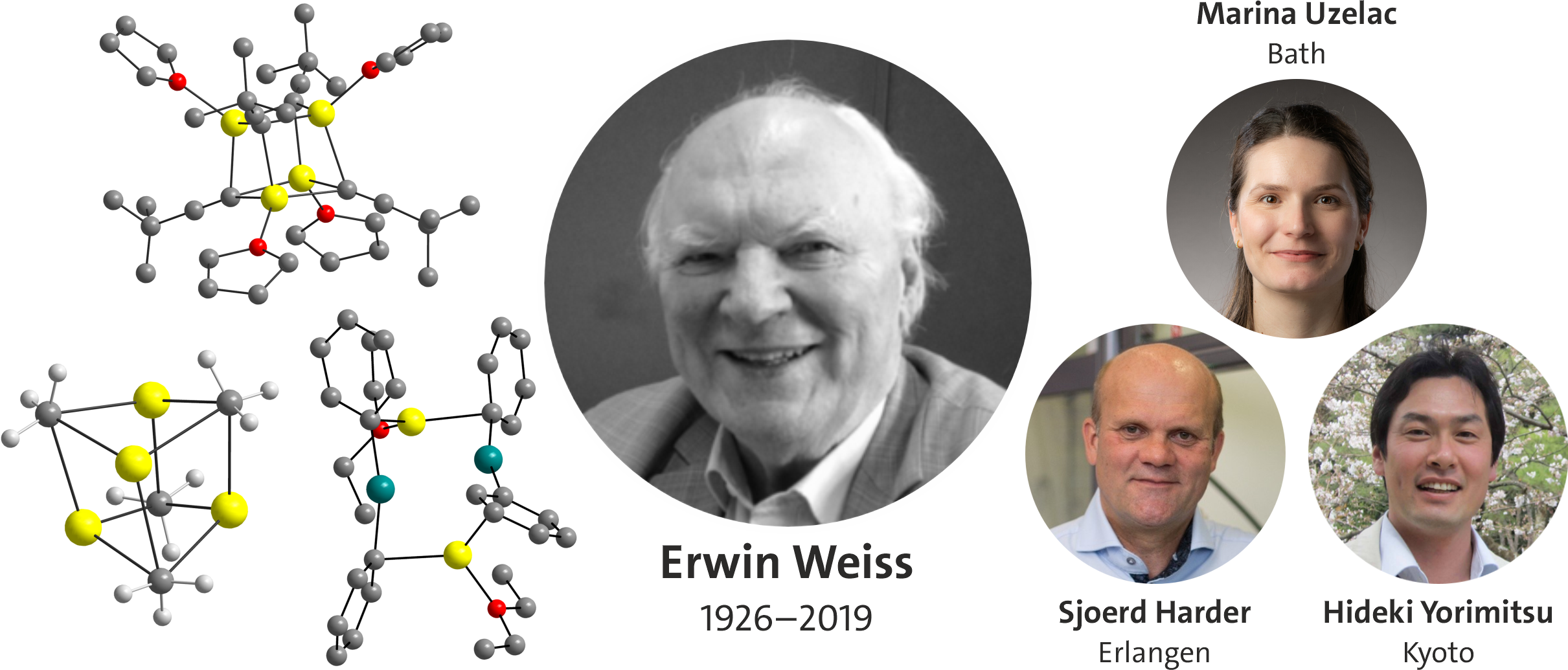
The Erwin Weiss Symposium will take place at the Department of
Chemistry, Lecture Hall D, on July 10, 2026, from 2.30–5.30 pm.
The full programme is now available.
Please register informally by email.(agjacobi-sek.chemie"AT"uni-hamburg.de?subject=Erwin%20Weiss%20Symposium)
Invitation
Dear colleagues and friends:
It is with great pleasure that we invite you to the Erwin Weiss Symposium on Friday, July 10, 2026.
This mini symposium will commemorate the scientific life and legacy of Prof. Erwin Weiss (1926–2019), who held the Chair of Inorganic Chemistry at the University of Hamburg from 1965 until 1991.
Scientific lectures by Dr. Marina Uzelac (Bath, UK), Prof. Sjoerd Harder (Erlangen, DE), and Prof. Hideki Yorimitsu (Kyoto, JP) will span modern applications of transition and main group organometallic chemistry to synthesis and catalysis.
Please come and join us on this event!
Dieter Schaarschmidt and Axel Jacobi von Wangelin on behalf of the Department of Chemistry
Short CV of Prof. Erwin Weiss
Erwin Weiss studied Chemistry at the TU Munich and graduated with a doctoral thesis "On the Structural Chemistry of Metal Carbonyl Compounds and Aromatic Complexes”, under the supervision of Walter Hieber in 1956. His experimental work included the pioneering proof of the crystal structure of bis(benzene)chromium, following its first syntheses by W. Hafner and Nobel laureate E. O. Fischer. Weiss later worked as research fellow at MIT (Cambridge, USA), ERA (Brussels, BE), and CERI (Geneva, CH) before accepting the call to the University of Hamburg. Following his early studies of the structural elucidation of methyl alkali metals, Prof. Weiss systematically extended the scope of his research to many novel organometallic compounds of the s-, p-, and d-block metals with a wide range of ligands, including carbonyls, olefins, and organyls. Prof. Weiss died at the age of 92 in 2019. Today his groundbreaking works are well recognized and continue to blossom in various aspects of modern organometallic chemistry, coordination chemistry, and catalysis.